Introduction
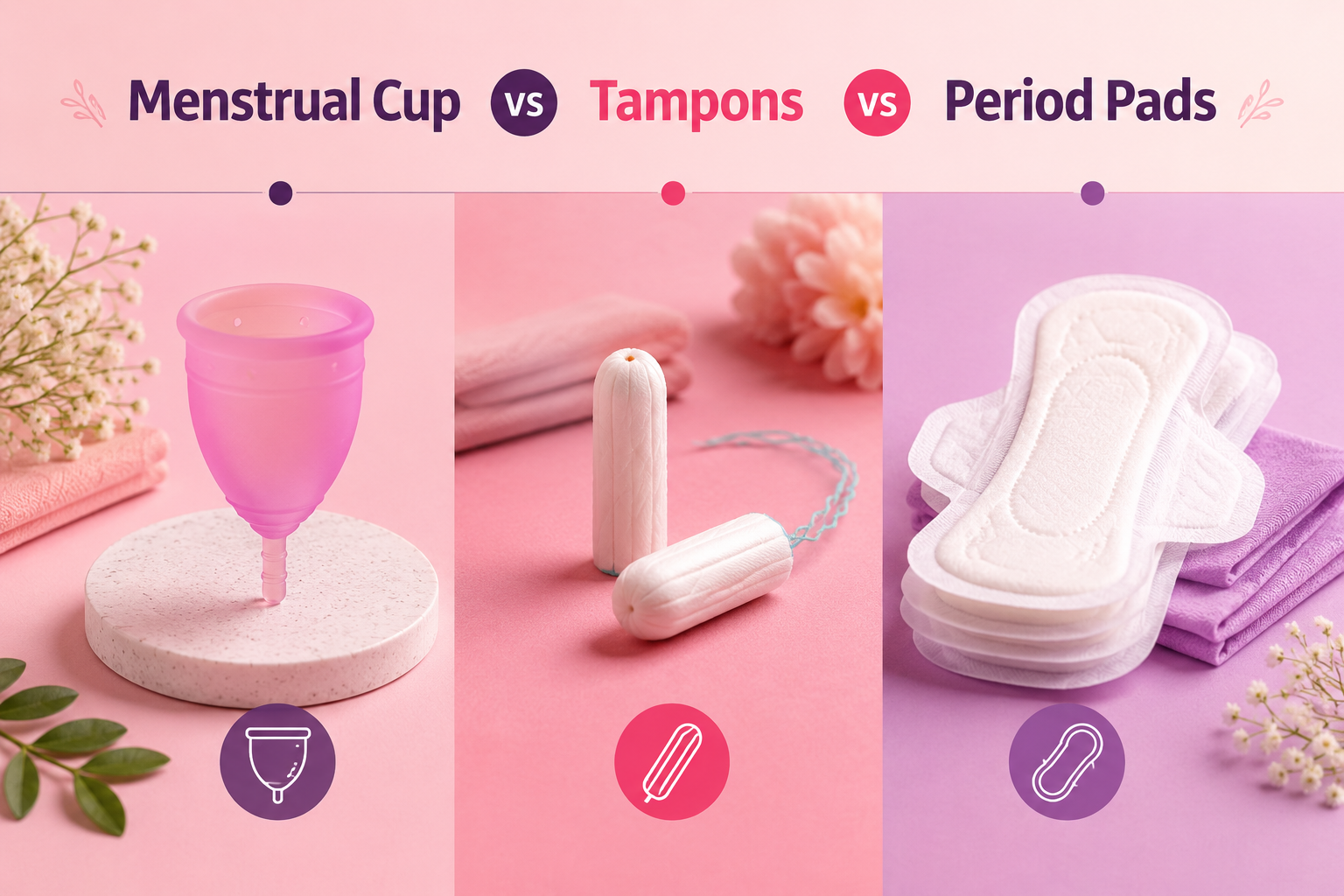
Menstrual Cup vs Tampons vs Period Pads is a common comparison, choosing the right menstrual product is an important part of menstrual health. With more options available than ever before, many people wonder whether menstrual cups, tampons, or period pads offer the best combination of comfort, safety, affordability, and convenience.
While period pads and tampons remain the most widely used menstrual hygiene products worldwide, reusable menstrual cups have gained significant attention due to their environmental and economic benefits. According to the Apple Women’s Health Study conducted by Harvard T.H. Chan School of Public Health, sanitary pads and tampons remain the most commonly used menstrual products, while menstrual cups are increasingly being adopted, particularly among younger adults.
This comprehensive guide compares menstrual cups, tampons, and period pads based on scientific research, health recommendations, user experience, cost, sustainability, and overall effectiveness.
Understanding Menstrual Hygiene Products
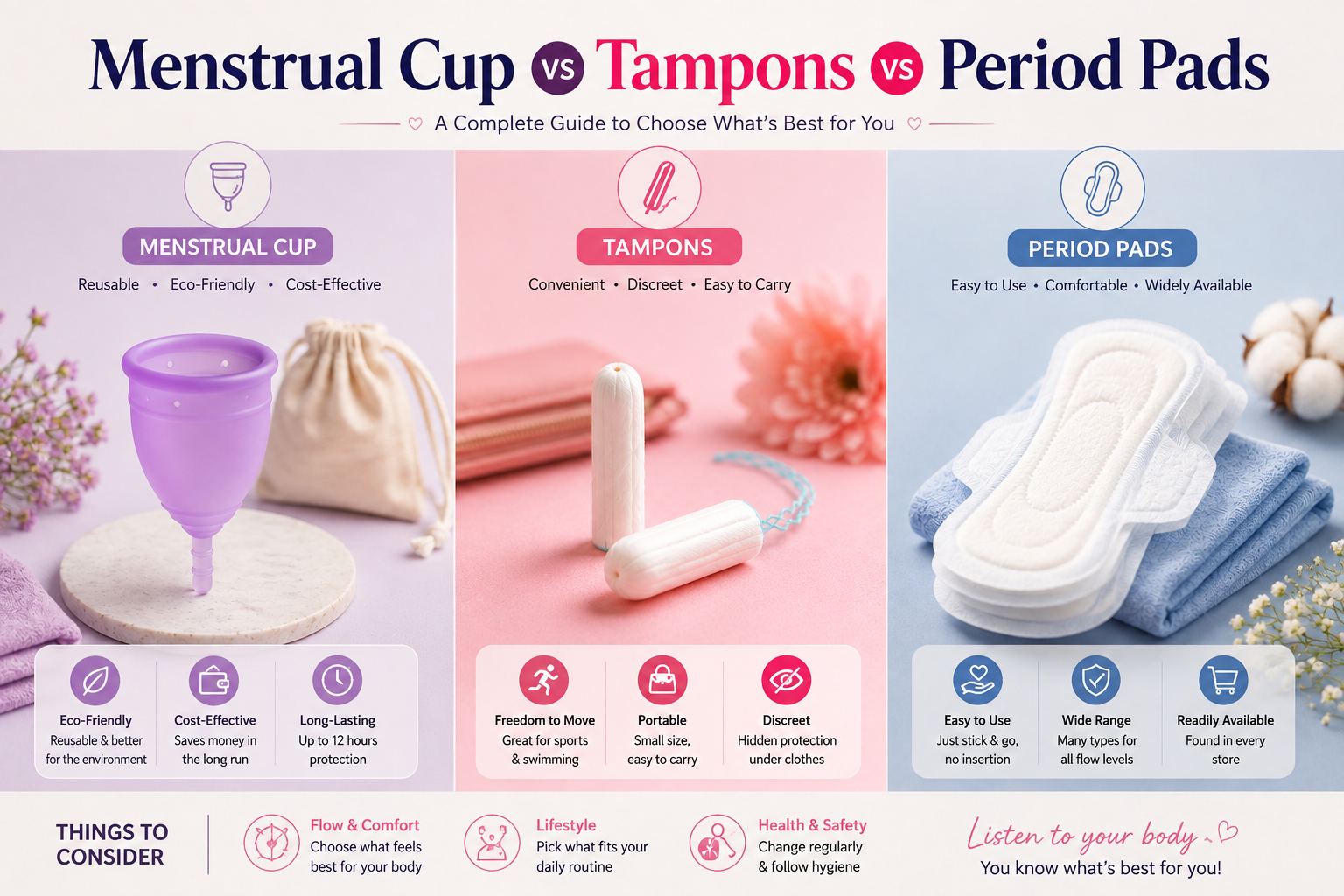
Menstrual hygiene products are designed to absorb or collect menstrual blood during a person’s period. The three most common options include:
- Period Pads (Sanitary Napkins)
- Tampons
- Menstrual Cups
The Centers for Disease Control and Prevention (CDC) emphasizes that regardless of the product chosen, proper menstrual hygiene practices are essential for preventing infections, reducing odors, and maintaining comfort during menstruation.
What Are Period Pads?
Period pads are absorbent products worn inside underwear to collect menstrual blood externally. They are available in different sizes, absorbencies, and styles, including daytime, overnight, and ultra-thin versions.
Advantages of Period Pads
Easy to Use
Pads are often the first menstrual product used during adolescence because they require no insertion and have a minimal learning curve.
Widely Available
They are accessible in supermarkets, pharmacies, schools, and healthcare facilities worldwide.
Suitable for Beginners
Individuals who are uncomfortable with internal menstrual products often find pads to be the most comfortable starting option.
Good for Overnight Protection
Many overnight pads offer extended coverage for sleeping.
Disadvantages of Period Pads
Ongoing Cost
Because pads are disposable, users must continuously purchase them throughout their reproductive years.
Environmental Waste
Disposable pads contribute significantly to landfill waste because they contain plastics and absorbent materials that degrade slowly.
Limited Comfort During Physical Activity
Pads may shift during exercise, sports, or extended movement
Potential Skin Irritation
Extended wear can sometimes lead to chafing, moisture buildup, or skin irritation.
What Are Tampons?
Tampons are cylindrical absorbent products inserted into the vagina to absorb menstrual blood before it exits the body.
According to data from the Apple Women’s Health Study involving more than 7,300 participants, regular tampons were the most commonly reported menstrual product, used by approximately 47% of respondents.
Advantages of Tampons
Discreet and Portable
Tampons are small, easy to carry, and generally invisible under clothing.
Suitable for Active Lifestyles
They are commonly preferred by athletes, swimmers, runners, and gym-goers.
Effective Leak Protection
When used correctly and matched to menstrual flow, tampons provide reliable protection.
Comfortable for Many Users
Many users report that they cannot feel a properly inserted tampon.
Disadvantages of Tampons
Frequent Replacement Required
The CDC recommends changing tampons every 4 to 8 hours and avoiding wearing a single tampon for more than 8 hours.
Risk of Toxic Shock Syndrome (TSS)
Although rare, prolonged tampon use has been associated with Toxic Shock Syndrome.
Recurring Expense
Like pads, tampons are disposable and require continuous purchases.
Vaginal Dryness
Some users experience dryness or discomfort, especially with higher absorbency tampons.
What Is a Menstrual Cup?
A menstrual cup is a reusable bell-shaped device typically made from medical-grade silicone, rubber, or thermoplastic elastomer. Unlike pads and tampons, a menstrual cup collects menstrual fluid rather than absorbing it.
Research comparing menstrual pads, tampons, and menstrual cups found that menstrual cups often performed better in terms of environmental impact, effectiveness, and long-term cost efficiency.
Advantages of Menstrual Cups
Reusable for Years
Most menstrual cups can last several years with proper care.
Significant Cost Savings
Although the initial purchase price is higher, long-term costs are substantially lower than disposable products.
Environmentally Friendly
One reusable cup can replace hundreds or even thousands of disposable menstrual products throughout its lifespan.
Longer Wear Time
Many menstrual cups can be worn safely for up to 12 hours depending on menstrual flow and manufacturer instructions.
High Fluid Capacity
Menstrual cups often hold more fluid than standard tampons, making them useful for heavy menstrual flow.
Disadvantages of Menstrual Cups
Learning Curve
Insertion and removal may require practice.
Cleaning Requirements
Users must clean and sanitize the cup according to manufacturer instructions.
Not Preferred by Everyone
Some individuals simply prefer disposable products for convenience.
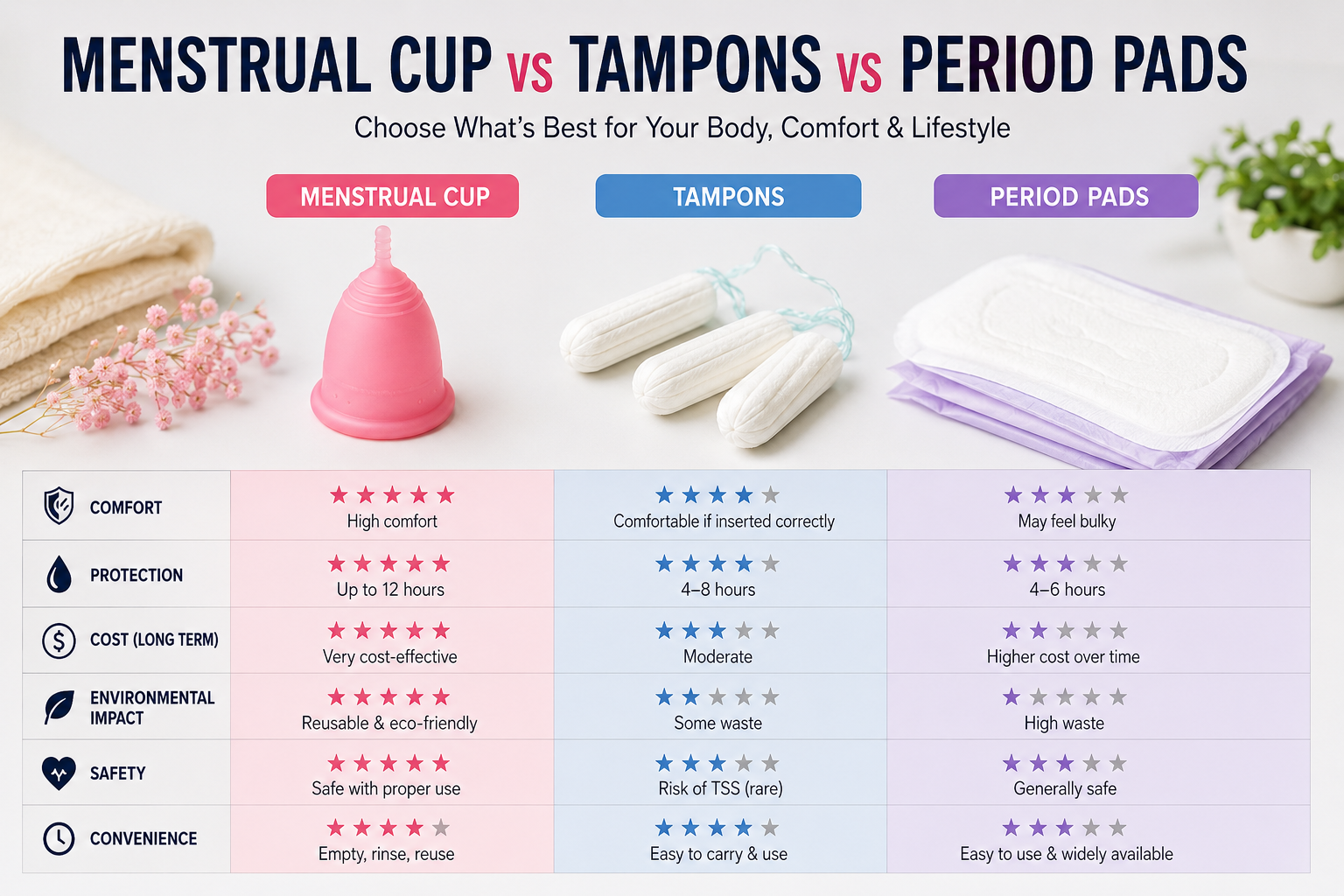
Menstrual Cup vs Tampons vs Period Pads: Detailed Comparison
| Comparison Factor | Menstrual Cup | Tampons | Period Pads | Winner |
|---|---|---|---|---|
| Comfort | Comfortable once inserted correctly; often unnoticeable during wear | Comfortable when properly inserted; suitable for active lifestyles | Easy to use but may feel bulky or noticeable during movement | Menstrual Cup & Tampons (Tie) |
| Safety | Strong safety profile when cleaned and used correctly | Safe when changed regularly; prolonged use may increase TSS risk | Generally safe but may cause skin irritation or rashes | Menstrual Cup |
| Cost (Long-Term) | One cup can last several years, reducing overall expense | Requires regular purchases every month | Requires regular purchases every month | Menstrual Cup |
| Environmental Impact | Reusable and generates minimal waste | Single-use product contributing to waste | Single-use product with significant environmental footprint | Menstrual Cup |
| Convenience | Can often be worn up to 12 hours before emptying | Typically requires changing every 4–8 hours | Usually changed every 3–6 hours depending on flow | Menstrual Cup |
| Leak Protection | High capacity and effective leak prevention when inserted properly | Good leak protection when matched to flow level | Effective but may shift during movement | Menstrual Cup |
| Best for Sports & Swimming | Excellent | Excellent | Not ideal | Menstrual Cup & Tampons (Tie) |
| Best for Heavy Flow | High fluid capacity and longer wear time | Effective but requires more frequent changes | Available in high-absorbency options but may need frequent replacement | Menstrual Cup |
| Beginner Friendliness | Requires practice and a learning curve | Moderate learning curve | Very easy to use | Period Pads |
| Travel Friendliness | Fewer changes needed and reusable | Convenient and portable | Easy to carry but requires more replacements | Menstrual Cup |
| Discretion Under Clothing | Virtually invisible | Virtually invisible | May be noticeable in some clothing styles | Menstrual Cup & Tampons (Tie) |
| Overall Value | Combines affordability, sustainability, convenience, and effectiveness | Convenient and widely used | Accessible and beginner-friendly | Menstrual Cup |
What Research Says About Menstrual Product Use
One of the largest recent studies examining menstrual product preferences is the Apple Women’s Health Study conducted by Harvard researchers.
Among 7,394 participants:
- 47% reported using regular tampons.
- 46% reported using sanitary pads.
- 19% reported using menstrual cups.
- 19% reported using period underwear.
The study also found that menstrual cups were especially popular among people in their 20s and 30s, suggesting growing acceptance of reusable menstrual products.
Meanwhile, a literature review comparing menstrual pads, tampons, and menstrual cups concluded that menstrual cups demonstrated advantages regarding hygiene, environmental sustainability, effectiveness, and long-term value.
Which Period Product Is Best for Different Users?
| User Type / Need | Recommended Product | Why It’s the Best Choice |
|---|---|---|
| Teenagers & First-Time Users | Period Pads | Easy to use, non-invasive, widely available, and requires no insertion, making them ideal for beginners. |
| Athletes & Active Individuals | Menstrual Cup / Tampons | Provide freedom of movement, stay secure during exercise, and are suitable for swimming and sports. |
| Heavy Flow Users | Menstrual Cup | Higher fluid capacity than most tampons and pads, allowing longer wear time with fewer changes. |
| Light to Moderate Flow Users | Any Product | Pads, tampons, and menstrual cups can all provide effective protection depending on personal preference. |
| Budget-Conscious Users | Menstrual Cup | Although the initial cost is higher, one cup can last for years, resulting in significant long-term savings. |
| Eco-Conscious Users | Menstrual Cup | Reusable design significantly reduces menstrual waste and environmental impact. |
| Frequent Travelers | Menstrual Cup | Can be worn for up to 12 hours, reducing the need for frequent changes while traveling. |
| Students & Working Professionals | Menstrual Cup | Longer wear time means fewer interruptions during classes, meetings, or work hours. |
| People with Sensitive Skin | Menstrual Cup / Tampons | May reduce skin irritation caused by prolonged contact with moist pads. Individual experiences may vary. |
| Swimming Enthusiasts | Menstrual Cup / Tampons | Both provide reliable protection while swimming and participating in water sports. |
| Overnight Protection | Menstrual Cup | Longer wear duration and higher capacity make it suitable for uninterrupted sleep. |
| People Uncomfortable with Internal Products | Period Pads | External protection offers comfort without insertion. |
| Users Seeking Maximum Convenience | Menstrual Cup | Requires fewer changes throughout the day and can be reused for years. |
CDC Recommendations for Good Menstrual Hygiene
To learn more about menstrual hygiene and period products, explore these expert resources:
- CDC Menstrual Hygiene Guidelines — Official recommendations for safe menstrual hygiene practices.
- Harvard Women’s Health Study on Menstrual Products — Research on how people choose pads, tampons, menstrual cups, and other period products.
- Harvard Health: How to Choose Period Products — Expert guidance on cost, comfort, safety, and environmental impact.
- Apple Women’s Health Study — Ongoing research exploring menstrual health and reproductive wellness.
Regardless of which menstrual product you choose, the CDC recommends:
- Wash your hands before and after handling menstrual products.
- Change menstrual products regularly.
- Follow manufacturer instructions.
- Change pads every few hours.
- Change tampons every 4–8 hours.
- Clean menstrual cups regularly and sanitize them after each cycle.
- Use unscented products when possible.
- Keep the genital area clean and dry.
Proper menstrual hygiene helps reduce discomfort, prevent irritation, and support overall reproductive health.
Frequently Asked Questions
1. Are menstrual cups safer than tampons?
Research suggests that menstrual cups have a strong safety profile when used correctly. Tampons are also safe when changed regularly according to guidelines.
2. Which is healthier: menstrual cup, tampon, or pad?
All three can be healthy choices when used properly. The best option depends on personal preference, comfort, and lifestyle.
3. Can teenagers use menstrual cups?
Yes. Menstrual cups can be used by teenagers, although some may prefer starting with pads before transitioning to internal products.
4. Are menstrual cups environmentally friendly?
Yes. Research indicates that menstrual cups have a substantially lower environmental impact than disposable menstrual products.
5. How often should a tampon be changed?
The CDC recommends changing tampons every 4 to 8 hours and never leaving one in for more than 8 hours.
Final Verdict: Menstrual Cup vs Tampons vs Period Pads
Menstrual Cup vs Tampons vs Period Pads each product has unique advantages.
- Period Pads are beginner-friendly, accessible, and easy to use.
- Tampons provide discretion and freedom for active lifestyles.
- Menstrual Cups excel in long-term affordability, environmental sustainability, capacity, and overall effectiveness.
Current research suggests that while pads and tampons remain the most widely used menstrual products, menstrual cups are becoming increasingly popular because of their economic and environmental benefits.
Ultimately, the best menstrual product is the one that aligns with your body, lifestyle, comfort level, and personal preferences. There is no one-size-fits-all solution—only the solution that works best for you. For foot care you may also look in https://www.radiantglowlab.com/category/feet-care/ article.
See Also: https://www.radiantglowlab.com/category/oral-care/